
How to Photograph Fireworks: A Complete Guide (Including Tips for Your Cell Phone!)
&layout=none&ref=https://www.lisamizephotography.com/blog/2026/6/how-to-photograph-fireworks-a-complete-guide-including-tips-for-your-cell-phone)
How to Photograph Fireworks: A Complete Guide to Settings, Safety & Getting the Shot!
Everything you need to know before the sky lights up!
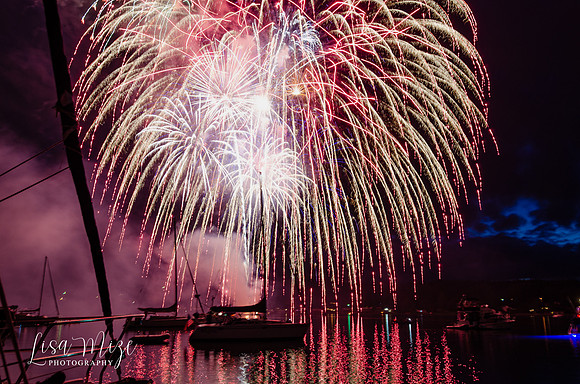

There's a particular kind of chaos to fireworks photography. You've got moving light, unpredictable timing, smoke drifting into your composition, a crowd pressing in around you, and exactly one shot at most of what you're trying to capture, because that exact burst will never happen again. But don't worry, there will be more! :)
The good news: fireworks are actually one of the most forgiving subjects in photography once you understand a few core principles! You don't need expensive gear. You don't need lightning reflexes. You need the right settings, a plan for the smoke, and a little patience.
Here's everything I've learned photographing fireworks over the years. My settings, safety, smoke management, and the small details that separate a forgettable shot from one you'll want to print.
What You'll Need
You don't need much, but a few things make a real difference:
A tripod. This is genuinely non-negotiable. Fireworks photography depends on long exposures, and there is no version of hand-holding a camera for a 2-4 second shot that produces a sharp image. If you only buy one piece of gear for this, make it a tripod!
A remote shutter release or your camera's self-timer. Pressing the shutter button by hand, even on a tripod, introduces enough vibration to soften your images. A wired or wireless remote is ideal; a 2-second self-timer is a perfectly good free alternative, but the remote release does give you better control.
Any lens that gets you reasonably wide. A 24-70mm or similar zoom range works beautifully for most shows. Wider lets you capture multiple bursts and a sense of place (skyline, crowd, water reflection); longer compresses and isolates a single burst. Bring both options if you have them, since you genuinely won't know which framing will work best until the show starts.
A flashlight or headlamp with a red-light mode, so you can see your camera settings without blinding everyone around you or ruining your own night vision! PLEASE!
An extra battery. Cold air and a long evening of live view shooting drain batteries faster than you'd expect.
Camera Settings for Fireworks
This is the part everyone wants the cheat sheet for, so here it is and then we'll talk about why these settings work!
The Starting Point
Mode:        Manual (M)
Aperture:    f/8 to f/16
Shutter:     2 to 6 seconds (start at 4 seconds)
ISO:         100
Focus:       Manual, set to infinity (or pre-focused
             on a distant light before dark)
White Balance: Daylight (avoid Auto White Balance,
             which can shift colors inconsistently
             between shots unless you don't mind editing later for consistency!)
File format: RAW
Why These Settings Work
Aperture (f/8–f/16): Fireworks are extremely bright, and a wide-open aperture will blow out the highlights into shapeless white blobs. A smaller aperture keeps the bursts crisp and properly exposed, and as a bonus, narrower apertures can produce subtle starburst effects on bright points of light!
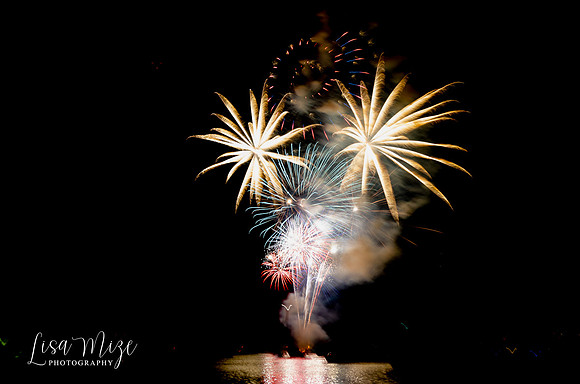
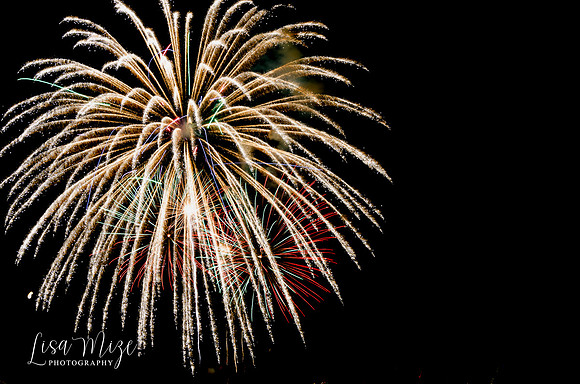
Shutter speed (2–6 seconds): This is where the actual magic happens. A long exposure is what lets you capture the full arc of a firework including the launch trail, the burst, and the falling embers, all as one continuous streak of light rather than a single frozen instant. Too short, and you'll just get a flat blob of light. Too long, and multiple bursts will overlap into a messy, overexposed tangle.
ISO 100: Keep it as low as possible. Fireworks are bright enough that you don't need the extra sensitivity, and a low ISO keeps your images clean and free of noise which is important since you'll likely be cropping or printing some of these!
Manual focus at infinity: Autofocus genuinely cannot keep up with fireworks in the dark and it will hunt uselessly against a black sky. Before the show starts, while there's still some light, autofocus on something far away (a building, a distant tree line) and then switch your lens to manual focus so it stays locked there. Don't touch it again for the rest of the night! Some cameras allow you to just focus by the infinity mark on your lens. Do some research on your camera before you go out for how to do this!
Adjusting as You Go
Take a test shot during the first few bursts and look at your histogram, not just the image on the back of your camera (screens lie to you in the dark and they look brighter than the actual exposure). If your highlights are clipping, narrow your aperture or shorten your shutter speed. If the bursts look dim and the sky looks like it's missing detail, do the opposite.
A practical technique many fireworks photographers use: set your shutter speed to "Bulb" mode instead of a fixed time. This lets you hold the shutter open manually (via your remote) for exactly as long as you want! You can open it the moment you see a launch trail begin, and close it once the burst has fully bloomed! This gives you far more creative control than a fixed shutter speed, especially for capturing multiple bursts in a single frame! (My definite technique!)
Composition: Don't Just Point at the Sky
The single biggest mistake in fireworks photography is treating it like sky photography. A perfectly exposed firework against an empty black sky is fine. A firework with something else in the frame is usually much better!
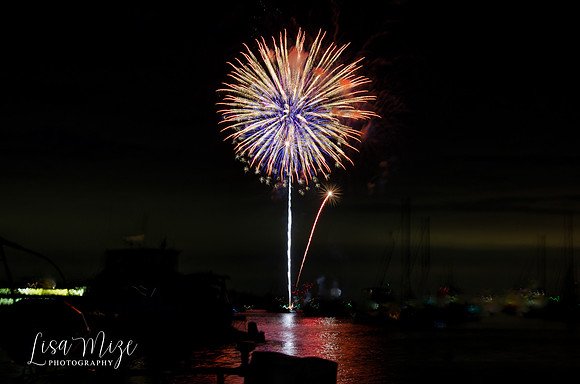
Find foreground interest before the show starts. Scout your location in daylight if at all possible. A skyline, a bridge, a body of water for reflections, a crowd silhouette, a tree line... any of these gives your image scale, context, and a reason to keep looking at it beyond the initial burst of color!
Leave room in your frame. Fireworks bloom larger than you expect, and they don't always burst in exactly the same spot. Frame a little wider than feels necessary so you don't clip the edges of a burst, and so you have room to crop later if needed.
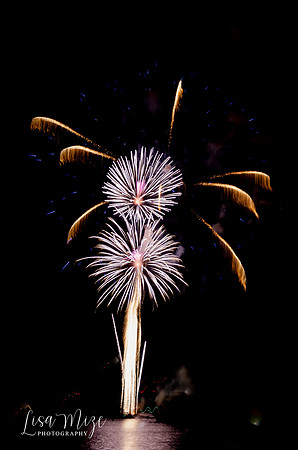
Try a vertical orientation for tall, single bursts, and horizontal for wide shows with multiple simultaneous launch points or when you're including a skyline.
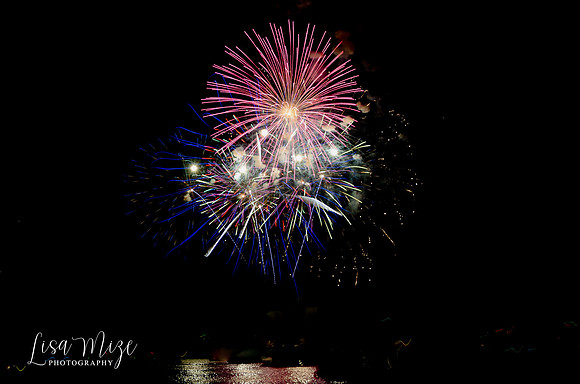
Watch for reflections. If you're near water, a still lake or harbor can double your fireworks display in the most striking way so just be ready for the water's surface to ripple and change between shots.
Managing Smoke — The Thing Nobody Warns You About
Smoke is the single most underestimated challenge in fireworks photography, and it gets worse as the show goes on. The first few minutes of any display will give you your cleanest images. By the grand finale, you may be shooting through a genuine haze!
Position yourself upwind. Check the wind direction before the show starts and if you are able to, position yourself so the breeze is carrying smoke away from you and your camera's sightline, not toward it. This single decision matters more than almost any camera setting.
Have a backup position in mind. If you notice smoke building in front of your original composition partway through the show, don't be afraid to move. A 50-foot shift can completely change what's between your lens and the bursts!
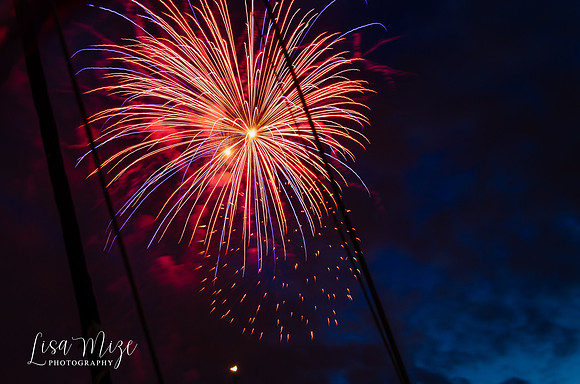
Accept some smoke as atmosphere, not failure. A little haze can actually add mood and depth to an image, especially with colored light diffusing through it. The goal isn't zero smoke, but it's avoiding the thick, blinding clouds that completely obscure a burst! (A little dehaze in post processing will be your friend!)
Shoot the opening bursts deliberately. Knowing that smoke accumulates over time, make your first several minutes count. Get your best, cleanest compositions early, and treat anything you capture later in the show as a bonus!
Watch for smoke drifting across your foreground subject, not just the sky. Smoke settling over a skyline or tree line can mute your foreground even when the sky itself is still relatively clear.
Fireworks Photography Safety
This section matters as much as any setting on this list and possibly more!
Maintain real distance. Follow all posted barriers and safety perimeters without exception. Fireworks displays are choreographed by professionals specifically because debris, malfunctions, and unexpected wind shifts are genuine risks. The distance that feels "close enough to get a great shot" is almost always still too close; a longer lens solves this problem far more safely than getting closer.
Protect your hearing. Professional displays are loud enough to cause real, lasting hearing damage at close range, especially repeated over an entire show. If you're shooting close to a display, consider basic ear protection.
Watch the ground, not just the sky. Crowded fireworks viewing areas are dark, uneven, and full of tripod legs, coolers, and blankets. Know your footing before you commit your attention upward for the next several minutes.
Be mindful of your tripod in a crowd. A tripod with legs spread wide is a tripping hazard in a packed viewing area, especially once it's dark and everyone's attention is on the sky instead of the ground. Choose your spot with this in mind, and consider a smaller footprint if you're somewhere genuinely crowded! I have even sat on the ground with my tripod lowered all the way down and I was still able to photograph from that location. I never had to worry about someone kicking over my tripod as it was so close to me with a very small footprint.
If you're driving afterward, plan for the exit. Fireworks shows end with thousands of people trying to leave at once. This isn't a photography tip exactly, but it's worth building into your plan, so know your parking situation and exit route before the show starts, not after!
Never photograph fireworks you are setting off yourself, or stand close enough to personal/consumer fireworks to photograph them safely. The settings and distances in this guide assume a professional, permitted public display with proper safety perimeters. Remember that consumer fireworks are unpredictable in ways professional displays are specifically engineered not to be.
Respect local laws and posted restrictions on drones, if that's part of your kit. Many fireworks displays operate within restricted or temporarily controlled airspace, and flying a drone near an active pyrotechnics show is both dangerous and, in many areas, illegal.
Stepping down off of my soapbox...
A Few More Things That Will Help
Arrive early, really early. The best positions at any popular fireworks viewing location fill up well before the show starts. Arriving early also gives you time to compose your shot in the remaining daylight, lock your focus, and settle in before the chaos begins.
Turn off image stabilization. With your camera locked on a tripod, stabilization systems can actually introduce blur as they search for a movement that isn't there. Turn it off once your camera is mounted and settled. (Note: I do not believe new cameras face this issue, but to be sure, turn it off!)
Shoot in RAW, always. Fireworks images often need real adjustment afterward like pulling back blown highlights, deepening the black sky, correcting white balance shifts. RAW files give you the flexibility to fix these things; JPEG often won't!
Don't chimp every shot. Checking your screen after every single burst means you're missing the next one. Take a few test shots early to dial in your settings, then trust your exposure and keep shooting, reviewing only periodically. Using your trigger release actually allows you to enjoy the show at the same time!
Capture the crowd too. Some of the most memorable images from any fireworks show aren't the bursts themselves, but they're the silhouettes of people watching, faces lit by colored light, kids on shoulders pointing at the sky. Don't spend the entire show only looking up!
Stay for the very end. The grand finale is often when multiple fireworks launch simultaneously, creating the fullest, most dramatic frames of the night, even through the heaviest smoke. It's worth working through the haze for these final moments. (Again, the dehaze slider in post processing can you help you out.)
Photographing Fireworks With Just Your Phone
Not everyone is hauling a tripod and a DSLR to a fireworks show, and that's completely fine as modern phone cameras are genuinely capable of beautiful fireworks shots if you work with their strengths instead of fighting their limitations!
Turn off your flash immediately. Your flash does nothing useful for a subject hundreds of feet away and will only wash out anything close to you. Most phones default to auto-flash, so check this before the show starts.
Find something to steady your phone against. You don't need a full tripod, but a small phone tripod, a fence railing, the roof of a car, or even bracing your elbows firmly against your body all help. Phone sensors are small and far more prone to visible shake than a dedicated camera, so any extra stability noticeably improves your results.
Use your phone's "Night Mode" or "Long Exposure" mode if it has one. Most phones released in the last several years have some version of this built in, and it's the closest equivalent to the long-exposure technique described above. If your phone allows manual control of shutter speed (many do, through a "Pro" or "Manual" camera mode or a third person software addition), aim for 1–3 seconds rather than the 2–6 seconds recommended for a dedicated camera as phone sensors handle long exposures differently, and shorter often looks cleaner!
Tap to focus on a distant point before the first burst, the same way you'd manually focus a regular camera. Tap on a building, a tree line, or anything far away, and if your phone allows you to lock focus and exposure (often by pressing and holding after tapping), do that so it doesn't keep hunting once the show starts.
Resist the urge to use digital zoom. Zooming in on a phone doesn't bring you closer, it just crops and degrades the image. You'll get a sharper, more usable photo by shooting wide and cropping afterward on a larger screen than by zooming in live!!!
Turn off Live Photos / Motion Photos. These modes work against you here, creating shaky, blurry mini-videos around your still image instead of one clean frame. A single well-timed still will always look better than a Live Photo of a firework.
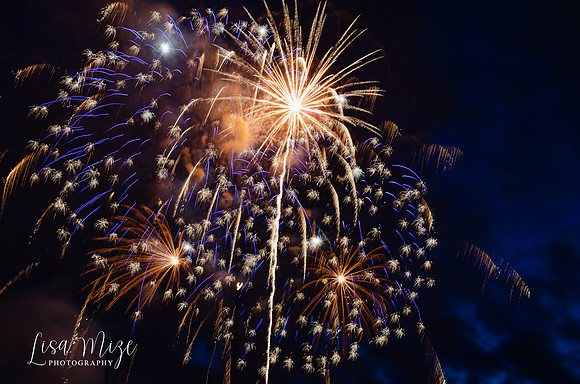
Try burst mode for the chaotic finale. When multiple fireworks are launching at once and a long exposure becomes harder to time well, holding down the shutter for a burst of rapid shots increases your odds of catching a great composition amid the chaos!
Keep your screen brightness low so you're not blinding your own night vision or the people around you between shots, and so you can actually judge your exposure more accurately in the dark.
Edit afterward, don't trust the in-the-moment preview. Like a dedicated camera's screen, your phone's display will often look brighter and more impressive in the dark than the photo actually is. Use your phone's built-in editor afterward to check exposure, pull back any blown highlights, and adjust contrast once you're somewhere with normal lighting to judge it properly.
Recap of your settings and tips for photographing fireworks:
Mode:           Manual (M) or Bulb for full control
Aperture:       f/8 – f/16
Shutter Speed:  2–6 seconds (or Bulb, timed by hand)
ISO:            100
Focus:          Manual, locked at infinity
White Balance:  Daylight
File Format:    RAW
Tripod:         Required
Remote/Timer:   Required
Stabilization:  Off
Position:       Upwind of the launch site
Fireworks photography rewards preparation more than almost any other type of photography, so by the time the first burst lights up the sky, your settings, focus, and composition should already be locked in, leaving you free to actually watch the show instead of fumbling with dials in the dark.
Get there early, find your wind direction, lock your focus before the light fades, and trust the process once the show begins. The rest is just patience, and the sky doing the hard work for you!
I'd love to see what you capture. If you try any of this out, tag me as I always love seeing how everyone sees the same sky a little differently!!!
Creating the extraordinary through YOUR lens,
Lisa
For helpful e-books and cheat sheets, check out my Etsy store: https://www.etsy.com/shop/LisaMizePhotography
A note on safety: This guide assumes you are photographing a professional, permitted public fireworks display from a designated viewing area. Always follow posted safety perimeters and the instructions of event staff or law enforcement on site.