
Abstract Nature Photography for Beginners: How to See It!

Abstract Nature Photography for Beginners: How to Train Your Eye to See It!

We all do it. We get a big idea in our head. We're going to go to this location, we're going to get this shot, and we have a plan! Then nature decides, just kidding, you're not getting any of that today!
You don't have to pack up and go home. That's when I start looking for abstract images. It can save your outing, and it can pull you out of a rut when you have no idea what to photograph. This is fairly new to me, over just the last couple of years, and I have completely fallen in love with it.
Here's a confession, too. I don't like editing. I'd rather be out taking photos. But I actually enjoy editing my abstract images, because there is no right and no wrong. I just change something and ask, does that feel right?
What is abstract nature photography?
Abstract photography moves beyond documentation. The goal isn't to show what something is. It's to show how it feels.
So the question changes. Instead of "what is that?" we ask "how does that make me feel?" You're photographing emotion, energy and sensation, and your viewer gets to bring their own interpretation. I might see one thing in an image, and you might see something completely different. That's one of the beautiful things about it!
Abstract or minimalist?
They overlap beautifully, and many minimalist images are semi-abstract. A minimalist image is simplified but still recognizable. An abstract image goes further, until it's just feeling and form.
What are you looking for?
Nature is full of the building blocks of an abstract image:
- Color: pure, saturated, soft, contrasting or monochromatic
- Shape: geometric, organic, repeating or isolated
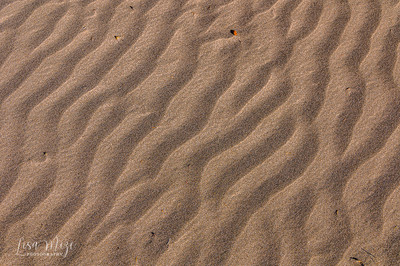
- Texture and pattern: rough, smooth, layered, delicate or bold
- Line: leading, curved, diagonal, converging or radiating
- Light: shadows, high contrast, silhouettes
- Movement: long exposures that create a feeling
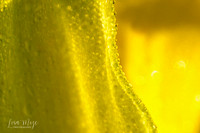
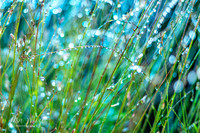
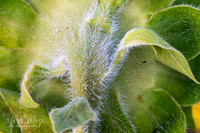
Six ways to start seeing abstractly
- Slow down. Look closer than you normally would. When you walk out on the Oregon coast, your eye goes right to the haystack rocks, the sunset and the waves. That's the grand view. Now look for the small things!
- Turn off your "subject brain." Look for elements, not things.
- Ask what you're drawn to. Is it a color? A shape? A texture? A line?
- Squint your eyes. Squint until the details disappear. Whatever is left might be what you want to go capture. I love this technique!
- Get closer. Then closer. Then closer again.
- Move your feet. Crouch, lie down, look up, look sideways. Shoot straight down from a bridge if you can. You can get a drone-like view without a drone!
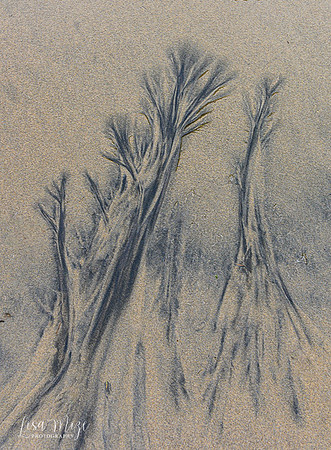
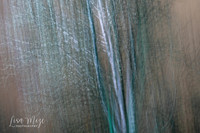
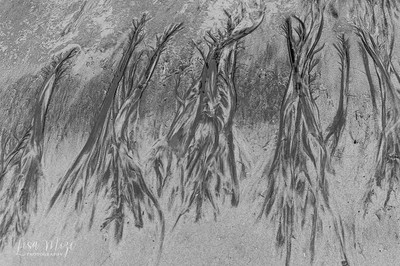
The image at the top of this post is a perfect example. I was on a beach in Oregon and looked down. The water going out had left dark sand in the shape of trees, complete with root systems. A few minutes later the tide came in and washed it away. That image will never exist again, and nobody else will ever take that picture! That's another thing I love about abstract work. You can be extremely unique!
What gear do you need?
Less than you think! Any camera works, and phone cameras can do a lot of this just fine. A macro lens opens up a whole world, but I don't even own one and I usually make it work. A zoom lens is great for going from the big to the little.
Shoot RAW if you can, because it helps when you edit. Manual mode is helpful, but you can use Shutter Priority for long exposures and Aperture Priority to control your depth of field. Your best piece of gear is your willingness to experiment and have fun!
Five questions to ask before you leave a location
I like checklists! Before you leave, ask yourself:
- Have I gotten close enough to lose recognition?
- Have I changed my perspective? Low, high, sideways?
- Have I tried movement? In-camera movement, zoom burst or panning?
- Have I looked for reflections in water or on wet surfaces?
- Have I found a texture worth filling the entire frame?
Keep your editing simple
If your settings were good, you may not need much. When I do edit, here's what I reach for:
- Crop aggressively. Remove everything that doesn't serve the feeling.
- Use Vibrance, not Saturation. Raise it for energy, or lower it for a soft watercolor feel. It's the same image with two totally different feelings.
- Adjust Texture and Clarity. Raise them to make a surface feel hard and crunchy, or lower them for something painterly and dreamlike.
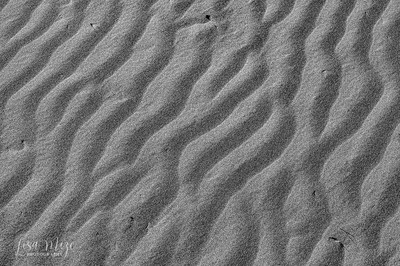
- Try black and white when color distracts from the form.
- Play with color grading. Monochromatic toning unifies an image.
- Add a gentle vignette to bring your viewer's eye in.
Yes, you will still have images you don't love. I have plenty that I look at and think, that just looks blurry! There's no right or wrong here, but you still get to choose what feels like you.
Go get creative!!!
Take it to the next level and check out our Abstract Nature Photography Notebook!!!
Watch the full YouTube session!