
Best Camera Settings for Wildlife Photography (Beginners)
&layout=none&ref=https://www.lisamizephotography.com/blog/2026/11/best-camera-settings-for-wildlife-photography-beginners)
Start With Shutter Speed:
The Wildlife Camera Settings I Actually Use
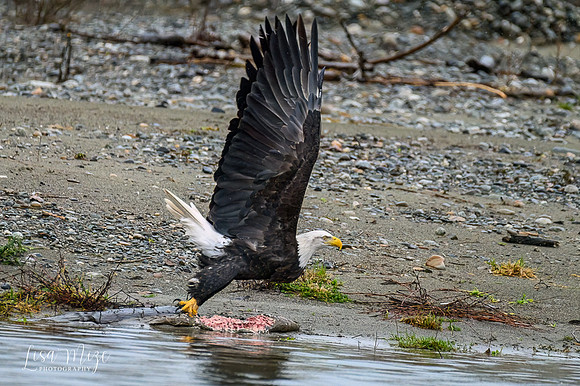

Wildlife doesn't wait for you. A split-second behavior happens once, and then it's gone! That's why, when I photograph wildlife, the very first decision I make is shutter speed.
I'll be honest with you. I'm not a master at this. I was a landscape and travel girl until a birding friend started pointing out birds to me a few years ago, and now I'm hooked. Here's everything I've learned about setting up your camera so you can skip some of my mistakes.
Shutter speed is king
Aperture, ISO and shutter speed all let light into your camera, but with wildlife, shutter speed matters most. It decides whether the motion is frozen or turns into a blur.
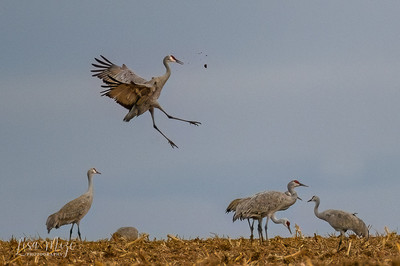
Think about an eagle soaring above you, a swan coming in for a landing, or a bear catching a salmon. We want to freeze those moments. A blur? Bleh! No good.
Pick your camera mode
If you don't shoot in full manual, go to Shutter Priority. It's S or Tv on your dial, depending on your camera. You choose the shutter speed and your camera handles the rest. Easy squeezy!
It's also a great way to learn. Instead of thinking about ten things at once, you only have to think about one.
If you shoot in manual, you can still set your ISO to Auto. You pick the shutter speed and aperture, and the camera adjusts ISO for you.
My starting settings
|
Setting |
Most wildlife |
Birds in flight |
|---|---|---|
|
Shutter speed |
1/1000 second |
1/2000 second - 1/4000 second |
|
Aperture |
f/5.6 to f/9 |
f/5.6 to f/9 |
|
ISO |
Auto, or whatever the light requires |
Auto, or whatever the light requires |
|
Drive |
Burst |
Burst |
|
Focus |
Animal eye AF if you have it, otherwise single point |
Animal eye AF if you have it, plus continuous AF (AF-C or AI Servo) |
|
File type |
RAW |
RAW |
These are starting points, not laws. If the animal isn't moving much, I might go down to 1/800. For a hummingbird, you'll need to go much faster if you want those tiny wings frozen. Or leave the wings soft for a really cool look! Your choice.
Check your shutter against your lens
Here's a great rule of thumb. Your slowest shutter speed should match your focal length. At 500mm, don't go below 1/500. At 300mm, don't go below 1/300, but wildlife does demand faster shutter speeds!
Personally? I double it, because I'm so paranoid about shake! At 500mm I usually shoot at 1/1000. At 300mm I usually shoot at 1/640. Once you're at about 400mm or longer, even a tiny movement can cost you sharpness.
Find your lens's sweet spot
Some people shoot wildlife wide open, and that's fantastic. For me, my lenses look a little soft and hazy until I reach about f/8 or f/9. That's where I get that rich look I want.
Every lens is different, so get out there and play. Find your own sweet spot before the big trip, not during it!
Don't be afraid of ISO
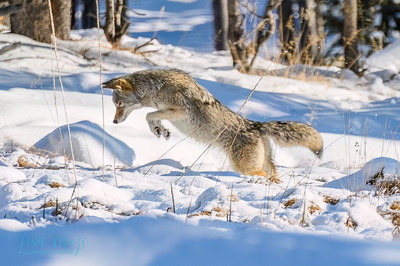
When the light drops, you can't slow your shutter to compensate. Set your shutter and aperture where you need them, and then trust your ISO to get you the rest of the way.
Cameras have come so far. You can shoot at ISO 12,000 and clean up the noise later with Topaz, Lightroom or DxO. A noisy image of the moment beats a clean image of a blur.
Auto ISO is a wonderful tool, but keep an eye on it. On safari, mine blew out my whites on a bird flying overhead, so I switched to setting ISO myself. Your camera will get it right many times. Just use it as a tool, and take over when it doesn't.
Focus on the eye
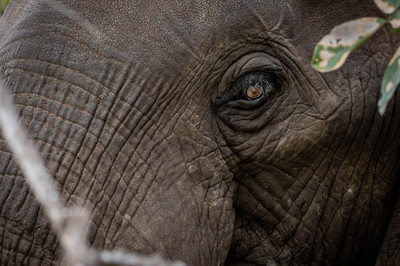
If you have animal eye autofocus, use it. I shoot a Nikon Z6 and don't have it, so I use single-point autofocus and aim for the eye. If the animal is too far away, I aim for the head. Eye first, head second!
Continuous autofocus tracks a moving bird, but it takes practice. Please don't throw your camera into AF-C for the first time out in the field and expect it to work. Practice ahead of time.
Use your burst
Continuous burst stacks the odds in your favor. My camera has a slow burst and a fast burst, and I haven't found a use for the fast one yet. That's a lot of images to go through! Try both and see which you like.
Histogram, histogram, histogram!
This is the thing I tell my students over and over. Don't rely on the little exposure meter alone. Turn on your histogram for image playback and look at it.
On my mirrorless camera, the image plays back in my viewfinder right after I shoot, so I can check it without lowering my camera. Am I blowing out my whites? Did I lose all my blacks? I can fix it on the fly rather than finding out at home. Turn on your blinkies too (or zebras, depending on your camera). They flash when your highlights are blown. This matters most with snow, skies and white birds.
The mistake that cost me half an hour of swans
Out in Skagit, Skagit Land Trust hosts swan viewing at Barney Lake, where trumpeter swans gather at the start and end of the day. It is an amazing experience!
I was so excited that I didn't check my settings. It was dark, and all I could think was, "I need more light, I need more light!" I shot for about half an hour at something like 1/250 of a second, and I got squat. Oops!
I finally picked my f-stop, sped up my shutter and raised my ISO. Now I try to make it a practice to stop and ask myself: Is my shutter fast enough? Am I freezing all of the action?
Tips of the wings
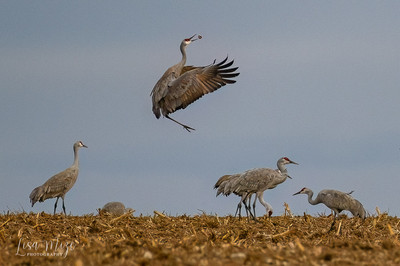
Here's how to check yourself. Zoom into your image and look at the tips of the wings. If they're blurry, your shutter wasn't fast enough. Speed it up and try again.
Your next step
Watch my YouTube session about wildlife!
Click here for a Wildlife Photography Field Planner!